• Planning Tools
    • 12-Month Planning Checklist
    • How To Get A Marriage License in Florida
    • How To Get A Marriage License in Georgia
    • How To Get A Marriage License in Tennessee
    • How To Get A Marriage License in South Carolina
    • How To Get A Marriage License in North Carolina
    • How To Get A Marriage License in Alabama
    • Wedding Budget & Tipping Guide
    • Questions to Ask Your Vendors
  • Venues
    • Art Galleries & Museums
    • Ballrooms
    • Banquet Halls
    • Barns & Farms
    • Ceremony
    • City/Downtown
    • Country Clubs & Golf Courses
    • Destination Weddings
    • Historic Locations
    • Hotels & Resorts
    • Industrial/Loft
    • Outdoor
    • Rehearsal Dinner
    • Restaurants
    • Waterfront
  • Vendors
    • Bands, Orchestras, DJs & Entertainers
    • Beauty, Hair & Makeup
    • Bridal Fashion
    • Cakes, Sweets & Desserts
    • Catering, Beverages, Ice Sculptures & Staffing
    • Event Rentals
    • Favors, Gifts, Registry & Your New Home
    • Floral, Décor & Event Design
    • Honeymoon
    • Invitations & Stationery
    • Jewelry
    • Men's Fashion
    • Officiants, Clergy & Other Services
    • Photography & Videography
    • Planning & Coordination
    • Transportation
  • Inspiring Ideas
    • Wedding Ideas
    • Spotlight on Style
    • Real Weddings
    • Styled Shoots
  • Articles & Advice
    • Beauty & Fitness
    • Budget
    • Cakes & Desserts
    • Catering & Cocktails
    • Expert Advice
    • Fashion & Jewelry
    • Honeymoon & Destination Weddings
    • How Much Does It Cost
    • New to the Scene
    • Planning
    • Trending Topics
    • Venues
    • Wedding Colors & Style
  • Magazines
  • Events
Menu
  • Planning Tools
    • 12-Month Planning Checklist
    • How To Get A Marriage License in Florida
    • How To Get A Marriage License in Georgia
    • Wedding Budget & Tipping Guide
    • Questions to Ask Your Vendors
  • Venues
    • Art Galleries & Museums
    • Ballrooms
    • Banquet Halls
    • Barns & Farms
    • Ceremony
    • City/Downtown
    • Country Clubs & Golf Courses
    • Destination Weddings
    • Historic Locations
    • Hotels & Resorts
    • Industrial/Loft
    • Outdoor
    • Rehearsal Dinner
    • Restaurants
    • Waterfront
  • Vendors
    • Bands, Orchestras, DJs & Entertainers
    • Beauty, Hair & Makeup
    • Bridal Fashion
    • Cakes, Sweets & Desserts
    • Catering, Beverages, Ice Sculptures & Staffing
    • Event Rentals
    • Favors, Gifts, Registry & Your New Home
    • Floral, Décor & Event Design
    • Honeymoon
    • Invitations & Stationery
    • Jewelry
    • Men's Fashion
    • Officiants, Clergy & Other Services
    • Photography & Videography
    • Planning & Coordination
    • Transportation
  • Inspiring Ideas
    • Wedding Ideas
    • Spotlight on Style
    • Real Weddings
    • Styled Shoots
  • Articles & Advice
    • Beauty & Fitness
    • Budget
    • Contest & Giveaway Winners
    • Engagement
    • Expert Advice
    • Fashion & Jewelry
    • Honeymoon & Destination Weddings
    • New to the Scene
    • Planning
    • Trending Topics
    • Wedding Colors & Style
    • All Articles
  • Magazines
  • Events
  • About
    • Advertise
    • Who We Are
    • Contact
    • Member Login

Not a Hair Out of Place: Beauty Trial Tips

Written by Christina Oddo & Yanira Garza | Photography by Ashley Galminas Photography

The flower arrangements are full, fresh and overwhelmingly gorgeous. The band sounds heavenly. And the groom, handsome as ever, awaits his bride. Yet as she heads down the aisle, something seems slightly off…

Hair and makeup are a critical part of your bridal look, but countless brides make the mistake of waiting until it’s too late to test out their desired style. The result of skipping your beauty trials? Unexpected fashion disasters. Whether it’s your bright red lipstick looking more cartoonish than sultry or your towering updo getting mistaken for a bobby pin arts-and- crafts project gone wrong, almost all beauty disasters can be avoided by scheduling a hair and makeup trial three to six months before your wedding. In addition to acting as an interview for your glam squad, trials are a chance for both you and your beauty professionals to work out any kinks before the big day arrives. Still not convinced? Read on to learn more about beauty trials and how they’re essential to perfecting your wedding day look.

FIND A TEAM OF PROS.

You found what you think may be the perfect salon; now it’s time to book a hair and makeup trial appointment.

You wouldn’t head out on a road trip without making sure that your car was good to go, right? Believe it or not, the same logic applies to your wedding hair and makeup. No matter how many inspiration images you show up with on the morning of your wedding, the only way to guarantee you get that perfect Adriana Lima smoky eye (and that you like the way it looks on you) is to test it out way ahead of time.

All reputable beauty stylists should be more than happy to set up a trial or consultation prior to your wedding day. After all, some wedding styles can get really complicated, especially if you want an updo complete with braids, curls or bobby pins galore. In addition to it being proper industry practice, trials actually take a load of stress off your stylists as well. By meeting with brides ahead of time, stylists are able to come up with a look that they know is doable and that you know you love. If you’re working with professionals, your beauty trials should be a fun and informative experience that gets you all the more excited for your wedding day.

START PREPPING.

All hair and makeup trials are slightly different because no two stylists are alike, but there are a few rules that ring true across the board. When it comes to scheduling, give your stylists ample time to test out multiple looks, and block out about one or two hours for the trial. Another important step is to come to the appointment with ideas, but try not to overwhelm your stylists. Bring a few inspiration images for both hair and makeup, but don’t show up with an entire scrapbook of looks. Limit yourself to a few favorites and let your stylists take the lead from there.

If you book a makeup trial, arrive with a fresh, clean face. Put on a little moisturizer if it’s part of your routine, but don’t coat your face in anything heavy or oily. It’s also a great idea to bring some of your beauty staples along with you in a small toiletry bag, especially if you have sensitive skin and are worried about the stylist using new products on you. In addition to giving your stylist a better idea of what your makeup must-haves are, asking him or her to incorporate a few items from your personal stash can give you that extra level of comfort.

If the trial is with a hair stylist, resist the urge to show up to the appointment with squeaky clean locks. Hair styling actually works best on day-old hair, so stay away from shampoo (yes, even dry shampoo) and other sprays the day of your trial. Then again, although most stylists recommend that you come with day-old hair, some prefer to work with clean hair. Make sure to ask your stylist’s preference a few days before your appointment.

Do you have a beautiful hair piece or veil you want to incorporate into your look? Bring any and all crowns, fascinators, veils and other wedding hair accessories you’re considering along to your trial. The morning of your wedding is not the time for your stylist to figure out how to secure your pearl tiara, so make life easier on both of you by giving your stylist a chance to play around with your accessories well before the big day.

THINK OUTSIDE THE BOX.

If you’ve ever wanted to experiment with a certain makeup look or hairstyle, consider testing it out during your trial. Now is the time to play around with false lashes, hair extensions and other beauty boosters you may have been too shy to try out in the past. Keep in mind that one of the most important parts of stepping outside of your comfort zone is being able to speak up and be honest. If you hate the way false lashes look on you, politely tell your stylist that you aren’t so crazy about them after all. A professional doesn’t get upset or offended. Instead, he or she is going to see your honesty as a sign of trust, not a knock on talent. Good beauty stylists care about perfecting your bridal look just as much as you do. Both of you want to make sure you feel confident and beautiful on your wedding day. The only way you’re both going to achieve that goal is if you’re open to new ideas, but also comfortable giving honest feedback.

ONE AND DONE … MAYBE.

Not 100% satisfied with your look post- consultation? It’s time to walk away. It’s not always easy, but think of it this way: If you aren’t totally in love with your look on your wedding day, you can’t reschedule the wedding and try again on a different day. The good news, though, is more often than not, most brides find themselves content with how their trial went.

If you fall into this happy category, but want to give your stylists the chance to work with you a few more times before the wedding, consider having them do your hair and makeup for your engagement shoot, bridal showers, bach party or other wedding events. The more your stylists understand your hair and skin, the happier you’re going to be with the way your wedding day look turns out. Whether you’re using your tried and true hairdresser, or you’re testing out a brand-new stylist, giving him or her the chance to work with you prior to your wedding day is essential. No matter how well you think the stylists know you or how highly your friends recommended them, it’s critical that you build a relationship with your stylists and ensure that they’re the perfect fit for your wedding day.


Browse Atlanta beauty, hair & makeup stylists here.

View Post

What to Consider When Picking Your Wedding Flowers

Written by Stephanie Jewell | Photography by Rachael Schirano Photography

Believe it or not, your choice of flowers may be one of the most impactful aspects of your wedding décor. Flowers have the power to really set the mood and evoke a magical atmosphere. The bridal bouquet is the floral element that everyone is sure to notice — the guests are going to be giving you all of their attention as you walk down the aisle and your bouquet is going to be right there with you, front and center.

Thinking through your bridal bouquet can be a great way to begin the process of determining your overall floral design. But it’s not as simple as just picking out a few kinds of flowers you like and leaving it at that. Did you know that there are several different shapes for bouquets? Are you thinking about any extras you may want to incorporate into your floral arrangements? Do you know which members of your wedding party get flowers? Your florist can walk you through all of these details, but coming in with a few ideas of what you may want is always helpful.

A SHAPE FOR EVERY STYLE

First things first — what style of bouquet do you want? Your florist may tell you that there are many ways to customize your bouquet to your style and shape is one of them. Ask to see examples of different kinds of bouquets and look at plenty of pictures ahead of time to get to know your preferences. Bring several photos to your floral appointment. You may not know the name of every flower or arrangement technique, but a picture is worth a thousand words!

If you’re looking for a larger bouquet, there are several options to consider. For a dramatic look, choose the cascading style, which includes longer flowers and greenery spilling out and down from the center to create a voluminous waterfall effect. Another related style is the pageant (sometimes called presentation) style, which features long-stemmed flowers gathered together, meant to rest in the crook of your arm. You can also opt for the hand- tied style, which features a mix of flowers and greenery loosely tied together with a visible ribbon or twine, achieving an organic “freshly picked” boho look.

For the classic bride, the round shape is timeless, featuring one or two types of flowers gathered in an arrangement that looks good from any angle, with stems wrapped completely in ribbon or with other adornments. Brides wanting a smaller bouquet can opt for the nosegay or posy style, which tends to feature just one or two types of flowers in a small rounded bundle that can easily be held in one hand. This look is popular for bridesmaids, leaving one hand free so they can help the bride with anything and everything in a pinch!

Shape is not the only physical element you have to take into account when thinking about your bouquet. You also have to pay attention to how big the bouquet is in relation to your body. For taller brides, the sky’s the limit — go for a cascading look or an overflowing bundle if you want. For shorter brides, it’s best to go for a smaller look. You don’t want your flowers to overshadow your face or cover up a large portion of your dress!

MATCH YOUR LOOK

Your bouquet never stands alone — it is always seen with your wedding gown as a backdrop. Because of this, it’s important to match your bouquet to the style of your dress. If you are wearing a more ornate dress, full of beading or intricately patterned lace, think about choosing a simpler bouquet so that your dress takes the spotlight. This may mean that you choose one color for the flowers or use fewer blooms. With a more modern, simple gown, you can either match the minimalistic look with a simple bouquet or you can go a bit more dramatic with the flowers. If you’d like the bouquet to take center stage, go ahead and mix many different kinds of flowers or use several colors together.

When you meet with your florist, be sure to bring along fabric swatches or detailed photos from your dress and your bridesmaids’ dresses. That way, he or she can see the exact color palette. For instance, your florist may use a different shade of flower to match a champagne- colored dress than he or she would for a bright white dress. And a pink bridesmaid dress may mean something quite different to you than to your florist.

Besides matching your general aesthetic, you want your flowers to make sense given your venue and the time of day you’re holding your wedding. An outdoor daytime wedding is perfect for bright and sunny blooms like sunflowers, tulips and peonies. The sunlight and open spaces allow those flowers to shine!

In contrast, if you’re having an evening wedding indoors, you need to keep in mind how your bouquet may look under the venue’s lighting and alongside the interior décor of the space. Does the lighting in your tall and spacious church allow all the details in your bouquet to be noticed? Is there colored carpet, tile or draping in your hotel ballroom? All your wedding plans should intertwine in some way or another. While you don’t need to necessarily match your flowers to the design elements of your space, it’s good to be mindful of them so they don’t clash with each other.

SEASONAL BLOOMS

No matter what aesthetic you are going for, the time of year that your celebrations occur play a huge part in your flower choices. If you have your heart set on daffodils, hosting your wedding in the fall is not going to bode well for your floral hopes. While many flowers are available throughout a large part of the year, there are some specialty blooms that you can only get during one season. Talk to your florist about which flowers you have in mind, and be ready to take his or her suggestions for alternative blooms that give you the look you’re going for. For instance, garden roses or hydrangeas can often substitute for peonies, which are beautiful, but only available for a very short amount of time.

Don’t think about seasonal availability as a limitation — embrace it! Try not to get attached to the particulars. Once you give your florist some inspiration photos and color schemes, let him or her run wild and use their professional knowledge to work floral magic. Chances are, your florist achieves a look that goes beyond your expectations.

WHO GETS WHAT?

After you decide on the shape, size and blooms for your bridal bouquet, you need to think about flowers for the other people who are helping you celebrate your big day. Of course, the bride gets the most dazzling bouquet, but who else gets bouquets, corsages and boutonnieres?

There are no hard and fast rules for this, so choose whomever you would like! But keep reading for some of the traditional guidelines.

BOUQUETS

Typically, each bridesmaid gets a bouquet that mimics or takes inspiration from the bride’s bouquet. You never run out of great photo ops when you and all your friends have beautiful blooms to show off. If your flower girl doesn’t have anything else in her hands (like a basket or a sign), it’s a cute idea to give her a mini bouquet as well. She’d love being your mini-me!

CORSAGES

Corsages are meant for the women in your family or any woman you would like to honor, including ceremony readers and other guests who have a special place in your big day. Whether you give corsages only to immediate family members (such as mothers and grandmothers) or you offer them to all your important cousins and aunts, be sure you are consistent with providing them to relatives on both sides of your families. You don’t want anyone to feel left out.

You may see women wearing corsages in different ways — some pinned onto dresses, mimicking how men wear boutonnieres. Many women pin the corsage on the left shoulder of their dress. But they may worry about snagging or ruining a delicate gown. An alternative is to opt for a bracelet-style corsage that is typically worn on the left wrist. Or you can ask your florist if he or she offers a magnetic option to minimize the risk of damage to expensive fabric.

Both wrist and pinned versions can look beautiful, so it’s best to go with whatever makes your special ladies feel most comfortable. You may find it helpful to talk to the mothers to see which style they would prefer and which option they think would work best for everyone.

BOUTONNIERES

Grooms and groomsmen typically wear boutonnieres, also known as buttonholes, which are pinned to their left lapel. But other men involved in your wedding can receive boutonnieres as well, including fathers and grandfathers of the couple, ushers, other family members and even the ring bearer. This is a special way to give a small thanks to the important men in your life.

SPECIAL TOUCHES

It’s easy to overlook the way your bouquet is held together, but don’t forget the finishing touches. Most bouquet styles have visible stems, which means that your wrap choice matters, and personalizing this part of your bouquet opens the door for creativity and allows you to show off what makes you unique.

The standard option for wrapping your stems is a satin ribbon in the color of your choice. But why not go beyond the traditional look? You can choose other materials to wrap your bouquet. Try burlap or twine if your wedding is rustic, velvet if you’re going for a elegant theme or lace from your mother’s wedding dress for a personal tribute.

Another way to upgrade your bouquet is to attach glitz or family heirlooms to the wrap. Going for a glamorous aesthetic? Ask your florist to attach some sparkly accessories like gemstone brooches or appliques. Or perhaps you’d like to honor your family history by incorporating some heirlooms into your bouquet. It could be a piece of your grandmother’s handkerchief, a locket passed down from generation to generation or even cufflinks from someone special.

After the celebrations are over, consider preserving your flowers so that you can insert them into a scrapbook or keep them as a token from your special day. Of course, there are professionals who can preserve your flowers to ensure the best quality. Do some research for the best professional preservationist that can encapsulate your flowers and wedding day memories for years to come.

Your bridal bouquet is one of the most visible aspects to your wedding day look, so take the time to think through all of your available options! Your florist can be a wealth of knowledge for you as you decide on all of the details. Remember to take advantage of him or her as a valuable resource as much as possible. By putting in extra love and effort, you can add major floral flair to your big day.


Browse area florists here.

View Post

7 Things to Consider for Your Wedding Ceremony

Written by Emma Sarran Webster | Photography by Carrie White Photography

While every couple’s wedding is unique, when it comes to planning the big day, it often seems that a large amount of focus and energy goes toward planning the perfect reception. Of course, the reception and all of its intricacies are indeed a big undertaking — but it’s only one part of your wedding day. The reception is a celebration of the ceremony that precedes it, and planning the ceremony takes time and effort as well. As you work toward putting together your perfect day, consider these seven key ceremony aspects.

1. THE ANGLES

Many ceremonies have a pretty standard setup: the couple and officiant are up front, the wedding party is on both sides and the guests are seated in rows (typically with an aisle in between). But that doesn’t mean every ceremony has to look that way. Depending on your venue, the layout could be slightly different. Make sure you discuss exactly how you envision everything laying out and how it may look with either your wedding planner or the venue manager prior to booking.

Some questions you may consider asking include: Where will you and your officiant stand? Will you be elevated slightly above your guests on a platform or on the same level? Where will your wedding party stand or sit? Where will your guests sit? Will everyone be able to see the action? It’s worth having a conversation with your photographer and videographer once you have the concept of the ceremony layout decided, so they can ensure they’re able to get the photographs and video they need.

2. THE DURATION

If you’re following a fairly traditional ceremony (such as a religious one), the length may be dictated by the predetermined elements of that ceremony. If not, it’s a good idea to consider how long you ideally want your ceremony to last before figuring out the individual parts of it. Do you want it to be a short and sweet 20 minutes, so you can quickly get your guests to cocktail hour? Or do you want to take more time — perhaps 45 minutes to an hour — to incorporate more involved components that are important to you and your partner?

Keep in mind that the length of the ceremony affects the rest of your schedule as well. When deciding on ceremony length, try mapping out a rough itinerary for the day by working backward from your reception. If the ceremony is 45 minutes, for example, what time will you need to start in order to get you and your guests to the reception on time? If the ceremony and reception are at the same venue, what time will you need to start to ensure the cocktail hour starts on time?

3. THE ORDER OF EVENTS

If you are putting together your ceremony without following a predetermined layout, it’s up to you to decide the order of events. Some of the most traditional elements of a ceremony include the processional, the officiant’s greeting and message to the couple, the declaration of intent, the readings, the vows, the exchange of rings, the pronouncement of marriage, the kiss, and the recessional. There are of course certain components that clearly fit into certain spots, but you have some freedom with the order of the ceremony, after all, it’s your ceremony. While you may find that plenty of couples do the declaration of intent immediately before the vows, for example, it’s completely fine to swap those two, or include a reading in between. You can intersperse a few readings throughout the ceremony or have them read consecutively. Try “storyboarding” the ceremony: write each element on a small piece of paper, lay them out in order, and then play around with them until you find an order that feels right for you and your partner.

4. THE EVENTS THEMSELVES

One of the most fun parts of planning your ceremony is deciding what elements you’ll include. Again, there are plenty of traditional components to a wedding ceremony, but you can decide which of those to use and not use, as well as any additional “events” you may fancy. The decisions can be based on whether the ceremony is religious, non-denominational, or perhaps a fusion of two different cultures. The ceremony can be based on what speaks to you and what best represents you as a couple. For example, you may want to include a memorial to loved ones, a thank you to your guests, a “Blessing of the Hands,” or a musical performance, the options are limitless.

Customize the content and wording of your big day as you would like. Don’t feel constrained to only the most common wedding readings. For example, if you want someone to recite the lyrics of your favorite song, go for it! And when it comes to things like the declaration of intent, there are many variations your officiant can use leading up to the “I do”. Browse online and find versions that really speak to you. Many people choose to incorporate a mini “unity ceremony” within the larger ceremony. If you go that route, consider what style of unity ceremony you would like – such as mixing two different colors of sand into one glass vase or using two separate candles to light one unity candle simultaneously.

5. THE MUSIC

There are a few things to think about when it comes to ceremony music. First, decide where you want music to be incorporated into your ceremony. Will it only be during the processional and recessional? Do you want anything to play softly in the background of events like the unity ceremony or ring exchange? Do you want to include a vocal or instrumental performance in the middle? Once you’ve made those decisions, you can move on to choosing the tunes and how the music will be played (such as live instrumentals via a string quartet or harp, a live vocalist, or recordings played over a speaker). If you’re working with a musician, they can likely play you some samples to help you decide your song selections.

6. THE PARTICIPANTS

The participants include the usual suspects: you, your future spouse, and your officiant, of course. But, who else will be involved in your ceremony? What roles will your wedding party play in the ceremony? Will they stand the entire time on either side of you or will they sit in the front row? Are there any additional tasks you need to assign them (like holding bouquets or rings)? Beyond the wedding party, consider how you might incorporate other important people into your ceremony. Perhaps you’ll have two parents light the individual candles ahead of the unity ceremony or ask a close friend to do a reading.

7. THE PHYSICAL ELEMENTS

Think about what types of physical elements to include in your ceremony. Will you get married under a chuppah or a wedding canopy? If so, plan ahead to secure the purchase or rental of the structure along with any additional components, like silk draping or an additional floral display. Don’t forget to confirm the logistics of delivery, set up, and break down. Then, there are the smaller pieces such as an aisle runner, a microphone, and a table for the unity ceremony. Many items like candles, chairs for your musicians, programs, as well as a card box may seem like small details that can be figured out last minute, but those small details can add up to big headaches when you’re trying to take care of them the week of your wedding. Get ahead of it by making a list early on, checking off when you acquire the items, and then delegating the plan to get each item to the ceremony on time.


Browse Chicago area ceremony venues here.

View Post

Fashion Feature: Simply Chic

Bridal looks by Jenny Yoo at Jenny Yoo Collection


View Post

Music to Your Ears: Creating the Perfect Wedding Soundtrack

Written by Emma Sarran Webster | Photography by Jasko Omerovic Photography

Hitting the Right Note

Music has a powerful way of conveying feelings and emotions. You know that one song that comes on the radio? Yeah, that song. The one that you have to stop what you’re doing to belt out the lyrics, reliving your college glory days? Well, now it’s time to think about what song you want to turn on to take you back in time to your first dance with your new spouse. This significant moment, among many others, will stand out to you as you look back on your big day.

By working closely with the musicians or DJ that you have chosen, you can craft the perfect soundtrack for your special day from the prelude at the ceremony to the last dance at the reception.

PRELUDE

Think of it as welcoming music. This is the music that is played as your guests arrive to the ceremony and find their seats. You should plan for about 30 minutes of prelude music to play in the background before the first person walks down the aisle. Many couples choose selections that incorporate harmonious music, instrumental tracks or soft acoustic songs. As you pick these melodies, remember that the prelude music will be among the first details to set the mood and tone of your big day.

WEDDING PARTY PROCESSIONAL

This processional is played when your wedding party and certain family members, like parents and grandparents, walk down the aisle. The processional music not only helps build anticipation and excitement for your entrance, but also sets the tone for the entire ceremony. A classical song like “Jesu, Joy of Man’s Desiring,” for example, can set the stage for a traditional Christian ceremony. If you’re planning an upbeat, unconventional ceremony, you can go the route of a modern pop song to let your guests know this wedding will be a more contemporary celebration from start to finish. Of course, you can also land somewhere in the middle, picking a song that holds meaning for you and your loved ones like a mellow, contemporary ballad.

Try to make sure that whatever you pick is different enough from the prelude music (which plays when guests are filtering in) so that everyone knows it’s officially time to start.

PRIMARY PROCESSIONAL

The moment the couple walks down the aisle is an immense one and music plays a big part in conveying the emotion that comes with it. A selection like “Canon in D” beautifully communicates a feeling of romance for both traditional and more contemporary ceremonies. But if you want to personalize this moment even more, you can choose a tune that holds personal significance to you, like the first song you ever danced to as a couple or one with lyrics that really speak to your relationship.

The primary processional music does not have to be different from the wedding party’s processional. If there is one song that speaks to you for both, feel free to stick with it, but consider pinpointing a spot within the music (such as a big crescendo or a key change) that adds an extra “oomph” to your entrance. If you use a song with lyrics, make sure you closely review what they are ahead of time. Plenty of breakup songs are set to beautiful melodies, and that’s not exactly something you want playing at your wedding.

RECESSIONAL

The recessional song, which begins when you and your new spouse walk back down the aisle, tends to be more celebratory and upbeat than the processionals. It’s the score behind the first steps you will take as a newly married couple and it begins the transition from your ceremony to your reception. Mendelssohn’s “Wedding March” is one of the most traditional tunes for this occasion as it imparts the importance of the moment with powerful beats.

There are plenty of other directions you can take depending on your personalities and the style of your wedding, though. For example, The Beatles’ “Here Comes the Sun” is a less emphatic, but equally joyful tune, and American Authors’ “Best Day of My Life” is perfect for the couple who loves a contemporary twist.

RECEPTION ENTRANCE

Your first official introduction to your guests as a newly married couple is during your recessional, but your entrance to the reception heralds the true start of the celebration. The music that plays when you and your new spouse walk into the room, and join your waiting guests sets the mood for the rest of the reception. For the rest of the night, your guests will take their cues from you, so if you are sending a message that says, “Let’s party and have fun!” they will heed it and join right in.

FIRST DANCE

Of all the musical moments throughout your wedding day, your first dance is perhaps the one that most clearly conveys who you are as a couple. All eyes will be on you, and while your dance moves play a part in showing your guests

your style, it’s the music that you are dancing to that really sends the message. An upbeat ‘90s classic, for example, can symbolize your quirkiness and lightheartedness, while an emotional ballad may represent your enduring love through good times and bad. Of course, choosing an upbeat song doesn’t mean you don’t have enduring love and vice versa. If you are having trouble deciding on a song, consider the overall vibe of your wedding and which of your top choices may fit that best.

FINAL SONG

After many emotional and joyful hours, your wedding day will finally come to a close. Just as the first song sets the tone for the reception, the last song punctuates that feeling upon your exit. It’s the last thing your guests will hear (and dance to!) before they leave. They may carry the feeling of that song with them as one of the strongest memories of your entire reception.

As with the other song selections, consider your personalities and the overall wedding vibe. You can choose to end the night on a romantic note with a sentimental ballad, such as “At Last” by Etta James, to represent your love. Or, you can conclude on a celebratory note with a high-energy song, such as “Shout” by The Isley Brothers, to get everyone on the dance floor one last time, or you can have the best of both worlds with a cheeky classic, such as “(I’ve Had) The Time of My Life” by Bill Medley and Jennifer Warnes. Have fun with this one — pick something that will send you and your guests off smiling.


Browse area bands, DJs and music entertainment here.

View Post

Style Trend: Luxe Textures

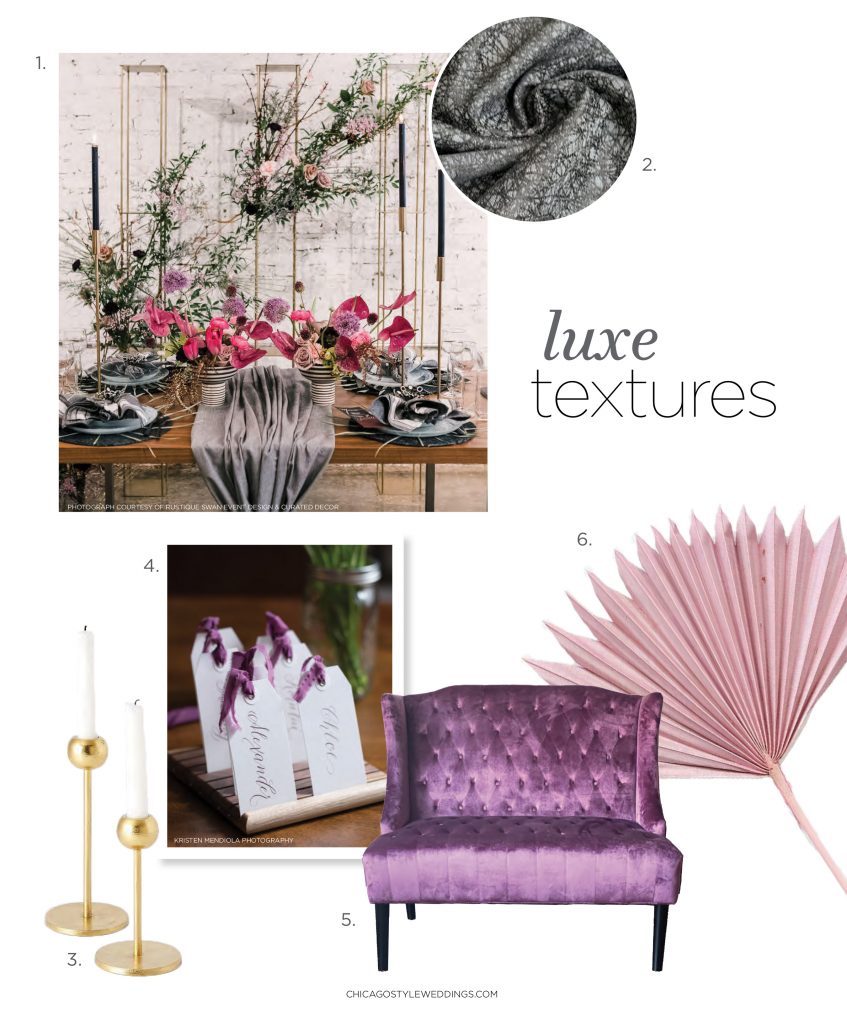
When it comes to wedding décor, color isn’t the only element that pops. Make sure to include multiple fiber textures such as velvet or woven fabrics, and fun patterns such as stripes or checks. For some extra flair, add some dimension by playing with candle and floral centerpieces at varying heights.

  1. Event Styling: Rustique Swan Event Design & Curated Decor
  2. Linens: F&S Linens
  3. Candleholders: West Elm
  4. Escort Cards: Nerissa B. Modern Calligraphy
  5. Settee: Chicago Vintage Weddings
  6. Dried Sun Palms: Afloral.com

View Post

Your Stress-Free Honeymoon Packing Guide

Written by E. Ce Miller | Photography by Jasko Omerovic Photography

If you have just finished the monumental task of planning an entire wedding, chances are the last thing you want to do is stress over planning and packing for your honeymoon.

After all, those post-wedding travels are specifically for you and your new spouse to kick back, relax and think about nothing other than how much you love one another … and when to order the next piña colada.

Anyone who has ever traveled before knows that things go much more smoothly if there’s been some planning involved — especially when it comes to packing for a trip you not only want to look and feel your best on, but also probably photograph extensively. (You still have that just-wedded glow, after all. No Instagram filter needed.) Knowing what to pack, how to keep everything organized and when to actually set those bags by the door can seem daunting, especially if you’re dealing with wedding planning burnout. But trust us, packing for your honeymoon can be much easier than you think.

WHAT TO PACK

Before we dive into what to pack, you probably want to make sure you have “the where” nailed down — flights booked, hotels reserved and any major activities planned. Make sure you know the climate and the actual forecast for your travel dates.

Next, be clear on what kind of trip you’re actually packing for. Are you an adventure-seeking couple looking to embark upon some extreme excursions? Are you a foodie duo planning on dining in some of the finest restaurants your destination has to offer? Maybe you are planning to kick back and relax on the beach with some books and beverages. Even if you don’t have a complete daily itinerary arranged, having a general idea of what kinds of activities you would like to do can help you know what items should fill your luggage.

The first items that should make their way into your carry-on luggage are all of your important travel documents. Set aside a folder and store everything in there. Travel documents include:

  • Airline tickets and confirmation numbers
  • Passports, visas and other necessary IDs
  • Credit cards or cash to convert if you’re traveling abroad
  • All hotel and activity reservations
  • Any medical information you may want to have on hand (including prescriptions in their original bottles)

Now comes the fun part! If there is ever a time to overpack (at least slightly), your honeymoon is that time. This isn’t the vacation to suddenly become stingy with your suitcase. If you’re not sure how many fancy evenings out you are going to be enjoying, pack assuming it is one or two more than you’re expecting. Include both practical and romantic lingerie. (Keeping it sultry 24/7 may seem like a good idea until you’re walking around the Bahamas in 100-degree heat.) Also, don’t forget a cozy airplane outfit and a versatile sweater for any chilly evenings.

The one exception to the overpacking rule is shoes. They’re heavy, they take up tons of space in your luggage and those strappy sandals are not worth honeymoon blisters. Grab activity-specific footwear (i.e., a pair for the beach, a pair for long walks, a pair for nights out and a versatile spare) and leave it at that.

Once you cover the basics, take into account those items that may not immediately come to mind. Is there a beachy book you are longing to read? Do you want print photographs as well as the thousands you undoubtedly take on your smartphone? If so, that nice camera belongs in your carry-on. If you’re not great at sleeping in unfamiliar spaces, throw some earplugs and a sleep mask in your bag as well. The last thing you want keeping you up all night on your honeymoon is the room of college students spring-breaking down the hall. If you’re honeymooning abroad, don’t forget things like outlet converters, basic language guides and any tourist books you may want.

HOW TO PACK

If you’re super-organized, now is the perfect time to put those skills into action. Consider packing for each day at a time instead of taking on the whole trip at once. This may eliminate some of that overpacking, although overpreparing is better than underpreparing. Go through a full day in your mind — from the moment you wake up until the moment you tuck yourself into that soft hotel bed.

WHEN TO PACK

Be sure to pack for your honeymoon well before the last-minute wedding preparations kick into high gear. Aim for two to three weeks before you’re set to walk down the aisle. If you are planning on leaving for your honeymoon straight from the wedding reception or early the next morning, make sure your wedding planner or a member of your bridal party is in charge of getting all those bags exactly where they need to be, so you can easily grab them and hit the road when it’s time. This person can also be in charge of your wedding dress, the gifts and all the other items from your wedding day.

See, that wasn’t so hard, was it? Happy trails!


Start planning your honeymoon here.

View Post

Perfectly Planned: Why You Should Hire a Wedding Planner

Written by Emily Conley | Photography by Photography by Lauryn

When was the last time you planned a large-scale, eight-hour party for 100 guests, including food, entertainment and extensive wardrobe selections? Unless you’re a professional event planner, chances are you never planned such an involved affair. But it can’t be that hard, right?

All in all, a wedding is really a complicated, full-scale party that requires hundreds of decisions and dozens of external vendors working together to pull off one fabulous event. Most of us don’t have the time, energy or expertise to put together a wedding completely on our own. But don’t despair, that’s when wedding planners enter to save the day.

When you hire a wedding planner, you are hiring someone to oversee all the details of your big day so you can sit back, relax and enjoy the party. Something like the electricity hookup for the catering staff is the last thing you need to think about before walking down the aisle to marry the love of your life. Do yourself a favor and take some of the wedding stress off yourself by hiring a professional.

Besides, due to the uncertainty caused by the coronavirus public health crisis, and its resulting restrictions and safety precautions, event planning just got that much more difficult. Wedding planners have the knowledge and experience to build flexibility into contracts while pivoting and adjusting strategy with your vendors if an unforeseen circumstance impacts your big day in any way.

When you’re ready to find your wedding planner, we have some of Chicago’s best right here in the pages of this issue. All you have to do is decide how much help you need. Are you starting to feel less stressed already?

TIERS OF SERVICE

Wedding planners generally offer different tiers of service, priced according to the amount of time involved and services offered in each category. Before hiring a wedding planner, you and your partner should decide how much of your budget you’re willing to spend, and how much help you truly need. Once you understand the volume of work you’re able to take on and how much you need or want to outsource, you can get to work finding a wedding planner who offers the type of assistance you need.

FULL-SERVICE WEDDING PLANNING

If you have an incredibly demanding job, chose to have your wedding in a location where you don’t live, or feel completely overwhelmed about how to start planning such a big event, then a full-service planner is probably the best choice. The investment for comprehensive wedding planning generally ranges from 10% to 20% of your total budget. In return, your planner helps you pick a wedding date, secure a venue and hone in on the specific style and vibe you want for your big day.

They will guide you through selecting your vendors, including a photographer, DJ, caterer, and florist. With his or her knowledge and recommendations, you can save hours of scrolling through reviews. Furthermore, your planner attends all vendor meetings with (or for) you and can assist with pricing negotiations. Depending on the wedding planner you work with, you’re probably going to receive at least one wedding planning assistant in addition to your full- time event planner. Full-service wedding planning typically begins shortly after you get engaged and runs through the day of your wedding.

PARTIAL WEDDING PLANNING

Wedding planners may have their own term for partial wedding planning, such as month-of planning, but it generally falls between full-service planning and day-of coordination. If you already booked a venue and have a general idea for what you want your wedding to be like, partial wedding planning services are perfect for you. You get help with establishing a wedding day timeline and narrowing down your design choices, while still maintaining control of the details. You’re probably going to have one or two sit- down meetings with your planner in the days leading up to your celebration, not to mention email access to your planner throughout the process.

If you decide partial planning services are right for you, be prepared to make some big decisions (like where and when to host your wedding) on your own, but feel confident knowing you have a professional to help you with the details.

DAY-OF WEDDING COORDINATION

The term “day of” is a bit misleading, as no one could come in only on your wedding day, and effectively manage all of the details and vendors. Day-of wedding coordination usually begins at least eight to 12 weeks before your big day. Your wedding coordinator meets with you once you’ve hired all of your outside vendors, and takes over to finalize details and confirm their coverage times for the actual day. You can expect your day-of coordinator to provide you with a timeline of events and manage the logistics of your wedding day. They also generally attend your rehearsal and coordinate any outstanding payments or gratuities.

WEDDING PLANNER OR SUPERHERO?

Most wedding planners are expert event planners with a touch of superhero thrown in. Weddings involve a lot of people and large numbers of people generally mean a few disasters are inevitable. Most planners have already solved every kind of crisis and most usually occur without the couple even knowing what had happened. From a grandparent passing out during the toasts (they were completely fine after getting some hydration) to a melting wedding cake, wedding planners are innate problem solvers. If they have been in business for a while, chances are there are very few issues they haven’t handled.

Imagine you’re in the stunning wedding dress of your dreams, you just married the love of your life and you are on your way to celebrate with everyone at your reception. You step out of the limo and straight into a spilled cherry slushie on the sidewalk. There’s red liquid staining your white dress and you are about to walk into a room full of people who are going to be looking right at you. If you hired an experienced wedding planner, there’s no need to cry. They’re going to whip out some of the white chalk they carry around for just this moment (who knew?) and color right over the glaring stain. No one’s ever going to know the difference. That moment right there is worth every penny you spent to hire a planning pro.

MONEY MATTERS

Weddings are not cheap. Even small, seemingly simple affairs require a significant investment. It can seem daunting to spend a chunk of your wedding budget on a planner, but not hiring a professional can end up costing you even more. Planners know the ins and outs of the local wedding market, which means they know which vendors you can trust and whom you should stay far away from. The expert advice and knowledge your wedding planner brings to the table can help you avoid expensive mistakes. A good wedding planner double-checks every contract and every decision to make sure all of the details are correct. They ensure you don’t end up with a room full of gardenias when you paid for peonies.

VISION AND REALITY

You may have dreamt of your wedding day for years. Maybe you know exactly what you want the room to look like when you walk in hand in hand with your new spouse to be introduced to your guests for the first time. Or perhaps you have a Pinterest board with thousands of ideas, overflowing with inspiration. While it’s fun to imagine things in your mind or look at them on a Pinterest board, bringing that vision to life is a challenge. One of the greatest benefits of a good wedding planner is his or her ability to look at your inspiration, talk to you about your desired style and vibe, and then turn those ideas and dreams into something magical.

A good wedding planner also knows the difference between Pinterest and reality. Your budget may not line up with your Pinterest dreams. He or she can help manipulate your budget and offer creative solutions to design your dream wedding, while keeping things realistic and within your budget. (However, one common misconception is that wedding planners can save couples money when it comes to negotiating contracts. While your planner may have a working relationship with a company that could cut costs a bit, a discount should never be expected.)

Wedding inspiration can quickly become overwhelming and impossible to wrangle. How do you pick a color palette that evokes the timeless, elegant vibe you know you want, but can’t really describe? How do you make sure you’re staying within your budget? A wedding planner has the expertise to take your dreams and intangible ideas, and turn them into a cohesive, gorgeously styled wedding day.

ADVICE AND MEDIATION

Weddings tend to cultivate unique conflicts. Bringing together two families is inherently tricky and, when you throw in all the logistical details and personal feelings involved in a wedding, the situation can get sticky. One of the best parts of having a wedding planner on board is that he or she can act as a mediator. Maybe you’re too scared to tell your future mother-in-law that you think her favorite flowers are tacky and ugly, but your wedding planner can tactfully inform her that you’re using specific floral arrangements without it feeling personal. If you have a particularly challenging bridesmaid who questions every decision, you can direct her to your wedding planner who always has your back.

Then there’s the plethora of advice you receive when you hire a planner. Not sure if a venue is big enough for your guest list? Your planner can tell you. Can’t decide if you should have live music or a DJ? Your planner can give you a rundown on the pros and cons of each, and help you make a decision. Completely lost when it comes to wedding gown styles? Your planner has seen every body type walk down the aisle and knows what gown is going to impress. Wedding planners live in the wedding world — they know what is trendy, tacky and tasteful.

WEDDING DAY DETAILS

It may seem obvious, but perhaps the biggest service a wedding planner provides is coordinating the actual wedding day. From what time your hair and makeup should be completed to sending the wedding party down the aisle, a planner has the knowledge and skills to make your day run flawlessly. Hiring a wedding planner also frees up your family members to enjoy your day instead of working to make sure everything goes to plan.

Your mom deserves to relax and enjoy your wedding day, too. You cannot coordinate your reception setup while you’re busy walking down the aisle and exchanging vows. It takes a lot of work and expertise to pull off a once-in-a-lifetime event. Even the most organized of couples can’t successfully enjoy their big day if they are simultaneously trying to manage it. Plan to hire a wedding planner and make sure there is room in your budget to cover the level of service you need before you make any other decisions.


Browse local wedding planners here.

View Post

Through the Lens: Everything Your Photographer Wishes You Knew

Written by Emily Conley | Photography by Jasko Omerovic Photography

Photographing a weddings is a great honor and photographers take the responsibility of capturing the lasting images of your big day quite seriously. Wedding photography is as rewarding as it is challenging. We pulled together an overview of what may seem familiar to you — a general timeline of wedding events — and focused on what your photographer wishes you knew about your big day through his or her lens.

You’ll find some professional tips and tricks for being the subject of a wedding photographer, as well as some obstacles and challenges your photographer handles that you may have never considered. Once you walk through your wedding from the perspective of a wedding photographer, you will be better prepared to enjoy your wedding day, communicate clearly with your photographer, avoid some major pitfalls and mistakes and come home with the best photographic memories of your big day.

PRE-WEDDING DAY: ENGAGEMENT SESSION

Our photography experts encourage all couples to schedule an engagement session because it is the perfect chance to get more comfortable in front of the camera and understand how professional photography works. When photographers meet a couple for an engagement session, they learn about how the couple interacts with each other, what their personalities are like and what they are most excited about for their wedding.

Most people are not used to being the stars of a photoshoot and can feel (and look) uncomfortable at first. Your engagement session is the perfect opportunity to work out those awkward moments, and learn how to relax and feel natural in front of the camera. You can also use your engagement session to practice posing — not a skill most people ever use. Try to listen to your photographer and follow their instructions, even if it feels weird. Trust us, they know what they’re doing.

Even if you choose to not schedule an engagement photo session, you should practice posing. The dramatic pose you saw in a fashion editorial may not translate well in reality, for example. (How does the model bend like that after all?) Why not try it in front of a mirror before you spring it onto your photographer and the world at large? Make it fun and include your soon-to-be spouse. Not only are you bound to have a couple of laughs, but you’re sure to come out of it with more confidence in front of the camera now that you know what does and does not work for you. Make sure to keep an extra eye on your posture while you practice — slouching is almost never attractive.

WEDDING DAY TIMELINE AND DAY-OF POINT PERSON

You absolutely need to have a clear and reasonable timeline detailing what you are doing from the time you wake up until you leave your reception. You also need someone who will help you stick to your timeline and make sure everything else is moving along. Our photography experts love when couples have a wedding planner or event coordinator because the day inevitably runs more smoothly and is more enjoyable for everyone. Furthermore, decide far ahead of time if you want to do a first look because having one (or not) can dramatically affect your day-of timeline.

Your wedding day should never feel like an eight-hour photoshoot, but without a clear schedule and an event planner to keep everything on track, it very well may feel like you are scrambling all day to get in all the photo opps you hoped for. Photographers are able to do their job — taking pictures — much better when your day is clearly mapped out and well-run. If you do not have a clear point person, they usually end up trying to direct everyone and field questions they don’t have the answers to. You are paying for your photographer to focus on capturing your big day, so make sure they aren’t distracted with trying to also act as a day-of coordinator. They aren’t going to do a good job at that, and your photos will not be the product you hoped and paid for.

GETTING READY

Most photographers quote an initial price based on six to eight hours of shooting time. This timeframe is generally long enough for a ceremony and most of a reception, but probably will not allow for your photographer to capture your getting ready moments. We strongly encourage you to add a few hours so you can include your photographer in your wedding prep time. The candid nature of this special time makes for some of the best pictures of the day.

If you do include your photographer in your prep time, there are a few things to keep in mind. First and foremost, make sure the space where you are getting ready is clean of clutter and trash. You don’t want a precious picture of you and your maid of honor toasting with mimosas ruined by undergarments or a piece of leftover pizza hanging out in the background. Ask someone in your wedding party to be in charge of making sure the room is decluttered and photo-ready. Second, let your photographer know about any cute gifts, customized attire or matching outfits you’d like captured.

COUPLE PORTRAITS

Whether you opt for a first look or not, couple portraits are an opportunity for you to spend some one-on-one time with your partner. Our photography experts highly recommend that you take these photos without your wedding party in tow. Let them head off to the cocktail hour or hang out somewhere else while you two get some time together. Taking portraits alone can also help you feel more relaxed and willing to engage in the intimate moments that often make for the sweetest photos.

It’s also best to trust your photographer with the location for these photos. You may not see the immediate appeal in a certain spot, but your photographer knows exactly how lighting and post-production editing can affect these shots. Photographers take photo locations seriously and are experts at knowing what looks best in the finished product.

DETAILS

You put countless hours into planning and designing your perfect day, so make sure you give your photographer a list of all the special details you want them to capture. Think about your centerpieces, table numbers, any special signage and all the other small details you want to remember for years to come. Don’t forget to bring an extra invitation suite with you so your photographer can get pretty shots of your stationery as well.

If you plan to give your partner a gift, letter or boudoir book, make sure you coordinate with your photographer so he or she can be ready to capture your partner’s reaction. Detail photos are perfect to share in your thank-you notes and you will love the memories of all the personal touches that made your big day special.

CEREMONY

Consult with your photographer before scheduling the time of your ceremony. Lighting is the most influential aspect of photography and can only be faked so much. If you schedule your ceremony outdoors when the sun is high in the sky, expect to have harsh sunlight and unattractive shadows. Photographers can edit to a certain extent, but bright sunshine makes everything more difficult. Also know that if you schedule your ceremony to take place at sunset, any post-ceremony pictures may be dark, and involve artificial lighting and flashes. Our experts recommend scheduling around sunset times to give yourself enough light for before, during and after ceremony photos that are neither too bright, nor too dark.

Once your ceremony is scheduled, make sure to let your photographer know about any special moments or elements of the ceremony that you want captured. He or she needs to know how long the ceremony is going to last to plan to be in place for each moment accordingly.

THE FIRST KISS

Our experts have two big tips for this one! First, don’t have a messy, involved kiss if you want an attractive picture of this special moment. Second, hold your sweet kiss for a bit to give your photographer time to capture it. If you have a lightning-fast peck, your photographer doesn’t have time to snap the iconic shot you’ve been dreaming about. You also may want to ask your officiant to refrain from making a silly face during this moment, as he or she may end up in the background of this shot.

GROUP AND FAMILY PORTRAITS

This can be one of the most difficult parts of a wedding day for your photographer if you haven’t prepared your family members ahead of time. Photographers know these family photos are very important (this is when mothers get the most anxious and upset about missing out on a photo they want), but they cannot possibly wrangle everyone themselves. Your photographer needs to know what photographs you want so he or she can make those shots happen.

However, your photographer doesn’t know your family or anyone’s names, so here’s where your prep work comes in. Tell everyone who needs to stay for family portraits exactly where they need to be and at what time. Give your wedding coordinator a list of family members’ names, and their relationship to you or your partner, so he or she can make sure everyone is accounted for. Photographers appreciate a list of combinations ahead of time (bride with parents, couple with groom’s side of the family, couple with both sets of parents, etc.), but still don’t know who is whom, so your coordinator may need to assist with names.

Plan for family photos to take at least 20 minutes (add an additional two minutes per photo if you want more than six to eight groupings) and make sure to allow for the necessary time to get in all the photos you want. Photographers can’t take pictures of 15 different combinations of people in 10 minutes. Prioritize your must-have group shots, and collaborate with your event coordinator and photographer to devise a plan for efficiently getting everyone into place.

RECEPTION

Let your photographer know what kinds of photos you are hoping to capture from your reception. If you are really into candids of guests dancing and partying, they can get those. If you would rather have more posed photos of guests, they can also make that happen.

Also, don’t forget to feed your photographer! They generally have a clause in their contract about providing a meal, but light snacks and water throughout the entire day are always appreciated as well. It’s best for your photographer to eat at the beginning of the reception so he or she is ready to take photos by the time you are finishing up. Give your photographer a timeline of anything special happening during the reception — from first dances to toasts and bouquet tosses — so he or she can make sure to be in the right place at the right time.

It’s up to you, but many photographers love when couples break away from the main party for a few minutes to take a few photos together. Whether this is a quiet dance under the lights on the patio, a walk at sunset or a posed portrait, it can be a nice way to snag a little alone time and also make for some gorgeous photos.

DAY-OF TIPS & TRICKS

Wedding photographers have truly seen it all — here are a few additional tips and tricks to make sure you are picture-perfect when it comes to your big day. Make sure someone has white chalk on hand in case you get any unfortunate stains on a white dress or shirt. Skip the spray tan — it almost never looks natural. Avoid any lotions or makeup with shimmer as they can reflect light and create an undesirable effect in your photos. Start your skincare routine and any skincare procedures early! Photographers can retouch photos to a certain extent, but no one can artificially create the gorgeous glow of healthy skin.

And last, but certainly not least, make sure you talk with your photographer about any questions or concerns you have before your big day! Your photographer wants to make sure the final photos are what you expect, so don’t assume he or she knows what you want without specifically communicating about it.

ADDITIONAL PHOTOGRAPHY SERVICES

After the big day, many of our experts have heard that couples wish they would have added on additional photography services. These services often include adding a few hours to their wedding photographer’s contract to have them capture the sweet details and moments of a wedding shower, the excitement and toasts of a rehearsal dinner, or the laidback charm of a post-wedding brunch. These are more relaxed, intimate moments of your wedding weekend that you will appreciate having photos of after all the excitement passes.

In addition to these extra wedding events, consider additional photography sessions. If you’re looking for a more sensual and playful option, photographers are seeing an increase in demand for boudoir photoshoots. This is perfect for the bride who wants to gift her partner with a photobook of steamy images on their wedding day. With a “trash the dress” session, photographers usually work with brides to choose an environment that starkly contrasts with the elegance of a wedding dress. These photos are generally dramatic and artistic, giving you a unique way to memorialize your fabulous wedding gown.


Browse Chicago area photographers here.

View Post

A World Away, Yet Close to Home: Destination Wedding 101

Written by Carrie Mantey | Photography by Emma Mullins Photography

If you’re like most engaged couples, the idea of having a destination wedding has crossed your mind at least once during the planning process. It’s easy to understand why.

Nothing says romance quite like getting hitched on a beach while palm fronds flutter overhead and your worries are thousands of miles away.

Though the idea of turning your wedding into a vacation is undeniably alluring, the unfortunate reality of cost and logistics often derails destination wedding plans. In addition to being expensive, destination weddings typically put an extra dose of pressure on your guests, too. On top of having to do quite a bit of extra traveling to even attend your wedding, your friends and family have to take time off of work and shell out cash for a flight. These hurdles may prevent your loved ones from being able to show up for your special day and this is what makes many abandon the idea of a destination wedding in the first place.

Believe it or not, though, it’s entirely possible to have the destination wedding of your dreams without ever stamping your passport or leaving the United States. Maybe you don’t have wild macaws flying overhead during your ceremony, but the U.S. offers plenty of wedding venues that deliver all the excitement and thrill of getting married away from home.

Places just over the border like Wisconsin and Michigan, or a little further away in an entirely different climate (hello, Florida or California), can still feel like faraway destinations and easily go toe to toe with almost any other popular destination wedding spot. Plus, planning a domestic destination celebration can be so much easier than an overseas wedding. No passports, no flights, no language barrier.

Are you a big-city kid looking to escape the hustle and bustle? The Midwest is brimming with gorgeous wilderness, rustic farmlands and charming lakeside resort towns not too far from Chicago. If it’s a fall wedding you’re craving, you have the extra benefit of taking advantage of the famous colorful show its trees put on every year. Do you still crave the city scene, but want to explore something new? Why not road-trip to Nashville or New Orleans for a change of pace?

An extra benefit to planning a domestic destination wedding is extending your stay past the wedding. Enjoy the local scene — absorb and explore the nearby state parks, beaches and museums. Maybe check into a nearby spa or treat yourself to a few nights in the honeymoon suite. Whatever you decide, remember that your wedding is about the celebration of your love, not where your gate-checked luggage ended up.


Start planning your destination wedding here.

View Post

Fashion Feature: Refined Romance

Bridal looks by Martina Liana found at Bella Bianca Bridal Couture, The Crystal Bride and Volle’s Bridal & Boutique

View Post

6 Tips for Outdoor Weddings

Written by Heather Hagy | Photography by TWA Photographic Artists

From blue skies and gentle breezes to longer days and busy nights, it’s no wonder that summer and fall are the popular times of year to get married. Outdoor weddings are becoming increasingly popular, but not without additional precautions. Events held outside can have their own unique set of problems. Here are some tips for ensuring your outdoor soirée goes off without a hitch.

HAVE A PLAN B (AND EVEN A PLAN C).

You can plan for many aspects of your wedding, but unfortunately, the weather is not one of them. During the planning process, work with your event coordinator to devise backup plans in case of inclement weather. This helps alleviate extra stress on the big day because you’ll already have plans in place if you need to shift. The best thing about backup plans is that they’re not one size fits all. You can take elements from one plan and incorporate them into another on the fly to craft a backup plan that’s perfect for your situation.

Common backup plans include having a tent on the grounds (look into ordering side panels to block any wind and rain), having an indoor option on standby, stalling start times if the weather is expected to clear and having outdoor heaters in case of an unexpected cold front. You can cross your fingers and hope you don’t need a backup plan, but you will be thankful you have one prepared regardless of the turnout. After all, rain on your wedding day is supposedly good luck, so you may as well be ready to tackle it head on.

OFFER A SEASONAL MENU.

Of the few details guests remember after a wedding, food is almost always one of them. Heat can do awful things to some menu items and can even make guests sick, so it’s critically important that your selections are made to withstand the hot summer sun. If your cocktail hour is taking place beneath the hot afternoon sun, for example, stick to seasonal veggies, fruit skewers and other light appetizers instead of heavy or dairy-based items that may melt or change texture due to heat. Also make sure all seafood, dairy and meat are stored in cooled serving dishes or on ice.

For dinner, consider comfort foods like pulled pork barbecue with a citrus salad or a pig roast with corn on the cob. These dishes are not only delicious, but bring instant nostalgia to the dog days of summer. Talk to your caterer about the best timeline options for your food in order to keep it appetizing and, most importantly, safe!

Pro tip: No matter how beautiful your cake, keep it somewhere cool before and after you cut it — you don’t want it to melt or collapse on the floor from too much sun exposure!

PREPARE FOR THE ELEMENTS.

As lovely as summer can be, it can also be pretty high maintenance in terms of staying comfortable. Anticipate your guests’ needs by making sure the ceremony and reception sites are equipped to combat the potentially warm weather. If you’re having ceremony programs, brainstorm ways to double them as fans or distribute mini battery- operated fans so guests can cool off if it’s hot. To keep guests hydrated at the ceremony, provide bottled water in themed ice buckets or a lemonade stand. Once the reception starts, move the hydration station near the dance floor — you and your guests will definitely need it later!

If you didn’t already book your wedding site, research venues that offer both indoor and outdoor party areas, so guests can decide where they would be more comfortable. If you already secured your space, talk to your event coordinator about how to use natural shade and other cooling options. Guests may also appreciate having sunscreen, lotion, bug spray and other seasonal remedies on hand. Place these items in decorative containers at the wedding site or put them in a bathroom basket so guests can grab what they need for on-the-go relief.

PLAY OFF YOUR SETTING.

While indoor-only venues may have their own rules, the décor options for outdoor weddings are practically limitless. Leverage the abundant space by using scenery and natural landscapes to your decorating advantage. Some ideas include creating signage for menu items, and directions to dinner and dancing locations. You can also use battery- operated lights to string through tree branches or line the top of a tent to help create a romantic, ambient atmosphere. Strung lights look especially pretty once the sun sets, too.

Outdoor weddings not only create a memorable setting, but they also make it easy to entertain. Consider personalizing bean bag sets with your names and wedding date, or providing bocce ball, horseshoes and other casual lawn games for the adults. Bubbles and kites are great for the kiddos in attendance. Once the sun sets, you can host a bonfire with a late-night s’mores or hot dog bar. When the night ends, have a sparkler sendoff in which guests light up the path from your reception to your getaway car or release paper lanterns into the sky, a longtime Asian tradition that symbolizes good wishes.

DRESS FOR SUCCESS.

Ensure comfort and confidence on your big day by making sure your look is summer ready. Whether it’s a dress or other formalwear, stick to lighter, breathable fabrics that will keep you cool. Work with your dress consultant to find a gown made of flowing fabrics, such as chiffon or crepe. If your heart is set on a gown made of heavier fabric, such as satin, consider changing into something more lightweight when it’s time to dance. Guarantee all-day comfort from head to toe by wearing block heels, flats or other shoes that don’t stick in the soft summer grass.

Keep your hair and makeup on point from morning to night by choosing styles that work with warm weather, not against it. Curls, waves and sculpted updos often don’t do well in humidity. To fight frizz, ask your stylist

to experiment with sleeker styles at your hair trials, such as a pulled-back bun or ponytail. For a boho vibe, try a chunky braid to keep your hair away from your face and off your neck. While it’s important that you look and feel your best, keep in mind that the more makeup you wear, the greater chance it may run by the end of the night, so play around with palettes that don’t require a lot of layers.

Pro tip: Have your maid of honor pack travel hair spray, blotting papers and a compact in her survival kit in case of a beauty emergency.

HAVE A SMART TIMELINE.

Guests don’t want to stand around in the sweltering sun while you’re off taking photos, so be mindful of when the sun may be at its highest and warmest points when planning your timeline. Not sure where to start? Research when the sun is expected to set in your wedding month and year, then build your timeline around that window. This helps keep guests comfortable and simultaneously guarantees ideal natural light for photos. For reference, the hottest part of the day is usually between 1 and 3 p.m. in the afternoon, give or take.

If temperatures are expected to be hot all around, consider shortening the time between your ceremony and reception, and talk to your event coordinator to devise a plan to keep your guests cool and comfortable. Also take into consideration the direction guests may be facing for the ceremony. Those having daytime nuptials should try to orient the ceremony so the sun is on your guests’ backs and not in their eyes. Guests appreciate not having to squint to see your vows and that you spared them a potentially painful sunburn.

Whether your wedding takes place in a garden or backyard, or on a mountain or beach, there’s something truly special about an outdoor wedding. While they come with more dos and don’ts than traditional weddings, outdoor weddings tend to offer more possibilities for innovation. Acing an outdoor wedding is easy with a little extra planning and organization. Follow these tips and your biggest wedding day worry will be making sure your champagne flute is always full.


Browse Chicago area outdoor venues now.

View Post

Seating Chart 101

Written by E. Ce Miller | Photography by Rachael Schirano Photography

Well, you’ve done it. You have finally settled on your guest list, sent out all those invitations you so thoughtfully designed and diligently gathered the RSVPs that came flooding in. It sounds like you, my friend, are smack dab in the thick of wedding planning. At this point, if there’s one task on that big day to-do list that you’ve been putting off, it’s probably the seating chart.

Compared to dress shopping, cake tasting, ring designing and floral arranging, planning the seating for your wedding reception can seem like a total snooze fest. But it’s also one of the more important elements of the entire day. How you choose to handle this task can either lead to a room full of smiling, dancing guests or an evening ending with awkward encounters between estranged family members. So, for better or for worse, it’s a task that you must complete.

The good news is that you don’t have to plan your seating chart alone. From that fantastic wedding planner you hired to your ever-helpful parents, there are plenty of people who will be more than happy to assist you as you take on the job ahead. Get started with these tips and tricks for a successful seating arrangement.

DON’T WAIT UNTIL THE LAST MINUTE.

If you are waiting for those last, lingering RSVPs to trickle in — don’t. If you have already followed up with your invited guests who haven’t responded and you still haven’t heard back, it’s the kids’ table or the highboy beside the DJ booth for them. (And honestly, even Miss Manners would say it serves them right.)

Putting off your seating chart until the last minute is a definite no-go. It’s a fairly substantial undertaking and just ask any wedding planner: They’ll say it’s something you’re going to want to get settled and off your mind sooner rather than later. (All the more energy you can spend focusing on veil length and custom cocktails — am I right?) If the deadline you gave your guests to RSVP has passed, and you’ve heard from most of the family and friends you are going to share your “I dos” with, it’s time to get cracking on the seating chart. So grab some of your favorite snacks — and your fiancé, of course — and start planning.

START WITH CATEGORIES.

Think: family, college friends, high school friends, office buddies, distant relatives, friends of your parents and — if they make the cut — all the kiddos. Organizing your guests by categories, whether that means making a list, an Excel sheet or labeled piles of RSVPs, will not only help you determine whom you want sitting where, it’ll also help you figure out which of your guests will be the most comfortable sitting next to each other.

While it may be tempting to sit your college roommate next to your BFF from grade school (you’ve always wanted them to become better friends and what better way to bond than over their mutual love of you, right?), if they’ve only spent a few passing moments together, neither one is going to appreciate an evening of inescapable small talk, especially if all their own friends are sitting elsewhere. This isn’t speed dating; it’s your wedding. Seat your guests next to the people that make them comfortable and whom they’re guaranteed to have the most fun with.

MAKE AN OFF LIMITS LIST AND THEN STICK TO IT.

Yes, off limits as in: These people can in no way sit within earshot, eyeshot or arm’s length of one another, under any circumstances. Put aside any dreams of your wedding day becoming the occasion upon which your estranged in-laws finally make peace and put those folks at opposite ends of the room (or at least opposite sides of a very large table) from one another. Nothing about too much champagne and a few sappy love songs says: “Maybe it’s time to reconcile.” You’ll thank us later!

KEEP YOUR BESTIES NEARBY.

While you won’t be spending much of your wedding reception seated (you’ll be greeting guests, circling the room, dancing, taking tons of photographs, etc.), you are going to want to sit down and actually eat the food you spent so much time sampling at some point. By placing a table of your BFFs between you (and your well-deserved meal) and the rest of the room, you won’t feel obligated to make casual conversation with your parents’ work pals while your chicken piccata gets cold. There will be plenty of time to chat with them later. Meanwhile, let that table of friends run interference while you eat.

DON’T BE AFRAID TO ASK FOR SOME INPUT.

Speaking of your parents’ work pals, unless you’ve been dropping in to visit your parents at the same office every week since you were a kid, chances are you don’t have a clue what the interpersonal dynamics of your parents’ workplaces are like. When it comes to seating the guests your parents invited to your wedding, enlist their help. I guarantee they will be more than happy to tell you who gets along best with whom and who has been fighting over replacing the photocopy paper for the past decade. Don’t be afraid to delegate.

REMEMBER: NOBODY LIKES A SINGLES TABLE.

While weddings were once a one-stop- shop for matchmaking (at least, that’s what the rom-coms from the ‘80s seem to portray), nowadays nobody — and that means nobody — likes a singles table. From the perspective of your guests, it can definitely be both a little bit embarrassing and a whole lot of boring. Seat your guests by the people they already know and love, and they’ll be guaranteed to have a good time.

Think your cousin and your coworker would totally hit it off? Find the time to introduce them before your wedding — maybe your instincts are spot on and they’ll end up as each other’s dates. If not, they won’t be forced to spend an evening awkwardly trying not to bump elbows as they cut into their beef Wellington.

ON THE FLIP SIDE: EVERYBODY APPRECIATES A KIDS’ TABLE.

Have the rug rats you know — and, OK, generally love — made the guest list? Then it’s definitely worth thinking about having a kids’ table. Not only will all of their parents have more fun with their littles stashed away in their own kid- approved space, the kiddos themselves will definitely have more fun seated with others their own age. It’s a win- win situation. Plus, if your caterer is featuring a few kid-friendly options on the menu, having all those little eaters seated in the same place will make your servers’ evening easier as well.

WHEN IT COMES TO ACTUALLY ARRANGING: WORK SMARTER, NOT HARDER.

So, you’ve thought about it all, now it’s time to actually diagram who belongs in what seats. Do so in a way that makes sense to you. If that means digital, snag a PDF of the reception floorplan from your wedding planner and start clicking keys. Does your brain run better on old-school technology? A giant bulletin board and some color-coordinated Post-its should do the trick. Are you a lover of lists? Then number (or name) each table and line up the guests accordingly.

Definitely keep the overall flow of the room in mind, too. For example, give your favorite guests the best seats in the house, put the kiddos closest to the bathrooms and don’t seat the grandparents next to the DJ’s giant speakers.

HAVE FUN WITH THE BIG DAY DISPLAY.

Now that the hard part of your seating chart is done, it’s time to have some fun! The seating chart is just one more fun and festive way to show off your big day style — so be sure to get creative (while keeping things organized and easy for your guests to understand, of course). A table lined with numbered cards is a simple and classic approach, but that’s definitely not the only way you have to go these days.

Want to welcome your guests by inviting them to imbibe that fancy bubbly you bought? Consider listing their table numbers on champagne glasses, alongside pretty, personalized glass tags. For a rustic wedding, string some rope across a few picket fence posts and attach your guests’ place cards with colorful clothespins. Is travel a trend in your relationship? Name each table after a location from your globetrotting lives and pin each place card to a giant map. Hosting your reception beneath some starry skies? Constellation-themed table numbers with corresponding place cards may be the way to go. If you’re celebrating all things vintage on your big day, a display of vintage picture frames, each featuring a different table, is cute and creative.

Have way too many guests to work in that much whimsy? Something as simple as an alphabetized board (in calligraphy, of course) may work for you.

STILL NOT INTO ASSIGNED SEATING? NO PROBLEM!

If assigned seating — and all the charting that goes with it — is just not for you, don’t worry. Assigning guests to a table and then letting them determine their own seating from there is a great way to keep all your guests organized without micromanaging every single detail. Is hosting a formal dinner not really the big day vibe you’re going for? In that case, consider some more creative seating, such as a mix of high and low tables, some couches and cushions, and a blend of indoor and outdoor arrangements (weather permitting). Pair more casual seating with hors d’oeuvres and a passed dinner, and your guests will be free to mingle, move around and change seats as they please.

No matter how you decide to seat your guests or what creative seating chart you incorporate into your big day, the most important thing to keep in mind is that seating arrangements are a great way to show your guests just how much you love them and appreciate their presence as you proclaim “I do.” Thoughtfully arranged seating will not only ensure success on your big day, but it will also tell your guests you thought about them and you are really glad they are there.

View Post

Hair & Makeup Trends: Fall 2020

Beauty is not a crash course to begin the night before your wedding. Ensure a good foundation for a healthy glow by always staying hydrated— inside and out. Drink lots of water and make sure your daily moisturizer gets some love. Once you get your beauty routine right, only then is it time to play with makeup. Before you set your sights on a certain makeup style, however, consider your best features and highlight those, while also taking into account the mood of your wedding to create your custom bridal look.


(Left) HAIR & MAKEUP Chanel J Makeup | (Middle) HAIR & MAKEUP Patty McGuire Hair & Makeup Artists; photography by Joy Lyn Photography | (Right) HAIR & MAKEUP One Salon and Bridal Co. and Custom Bridal Gowns


PRO TIP: Use a beautiful hair comb or accessory to pull almost any hairstyle together, while adding a touch of class.   – Bridal Brigade

(Left) HAIR Bridal Brigade; photography by Caitlin and Luke Photography | (Right) HAIR & MAKEUP Zazú Salons

  1. PRIMER Tom Ford Illuminating Primer, Recommended by Chanel J Makeup
  2. BLUSH Fenty Cheeks Out Freestyle Cream Blush in Petal Poppin
  3. SILK PILLOWCASE Fishers Finery 25 Momme Mulberry Standard Silk Pillowcase
  4. SHEET MASK Masque Bar Naturals Rose Sheet Mask
  5. MOISTURIZER Urban Skin Rx Radiant & Bright Glowing Moisturizer, Recommended by Chanel J Makeup
  6. EXFOLIANT Sonia Roselli sexApeel Instant Exfoliation Spray, Recommended by Bridal Brigade
  7. HIGHLIGHTER Hourglass Ambient Lighting Palette, Recommended by Patty McGuire Hair & Makeup Artists
  8. CONCEALER Tarte Shape Tape Concealer
  9. LIPSTICK Charlotte Tilbury – Pillow Talk, Recommended by Patty McGuire Hair & Makeup Artists
  10. TEXTURIZING POWDER SexyHair Big Powder Play Lite, Recommended by Patty McGuire Hair & Makeup Artists
  11. BROW CRAYON Anastasia Beverly Hills Brow Wiz

View Post

Honeymoon Vibes: Your Must-Have Essentials

Packing for your honeymoon while finishing wedding planning can be stressful. Whether you’re headed to an exotic beach or exploring a national park, don’t forget to pack the essentials. And just because they’re essentials doesn’t mean they have to be boring!

1. Genevieve Rose Atelier Cocos Sun Hat
2. fresh Sugar Rosé Tinted Lip Treatment Sunscreen SPF 15
3. Mark & Graham Leather Luggage Tag
4. Uncommon James x DIFF Retro Sunglasses
5. QALO Stackable Silicone Wedding Ring
6. Supergoop! Unseen Sunscreen
7. Katie Kime Banana Leaves Pajama Set


Start planning your honeymoon here.

View Post

Posts pagination

Previous page Page 1 … Page 13 Page 14 Page 15 … Page 21 Next page

Atlanta Style Weddings

  • About
  • Contact Us
  • Submissions
  • Magazines
  • Advertising
  • Advertiser Resources
  • Privacy Policy
  • Terms of Use
  • Sister Publications

Planning Your Wedding

  • Venues
  • Vendors
  • Planning Tools
  • Ideas & Inspiration
  • Real Weddings
  • Articles & Advice
© 2026 Atlanta Style Weddings/Nei-Turner Media Group.
Crafted by: Bold City Agency